Across underground scenes to niche online spaces, queer culture continues far beyond Pride Month – but what does it look like outside of June narratives? We’ve asked our editors to spotlight the communities and movements sustaining queer life year-round
Pride Month is often framed as a moment where people and brands celebrate queer culture with core moments, brand activity and more. But it often arrives, peaks and then fades out of view – and even during Pride Month, that feeling of representation can be limited. This is reflected in the data: just 59% of people felt at least somewhat represented by Pride Month. Meanwhile, 23% said they feel suspicious of brands or companies that throw Pride Month campaigns, while 19% said it felt performative.
Beyond June narratives, queer culture is not a single aesthetic, unified story or month-long event for brands to create temporary activations that don’t go beyond the month. It is constantly evolving and ever-present across culture, from underground club nights where music, fashion and identity are constantly being reworked to long-standing activist networks that continue to organise, support and advocate without the visibility that often accompanies Pride Month. It is carried by institutions – bars, archives, community centres, independent publications – that have held space for decades and is increasingly thriving in niche online communities, where identity, care and discourse are shaped in real time.
Queer culture is continuously shaping everyday infrastructures, communities and creative spaces year-round – and in this edition of Inside Culture, our editors have shared something that reflects queer life outside of June narratives – whether that is a space, a movement, a community or a cultural signal that feels meaningful right now.
Floptropica
Floptropica is a niche online community (and fictional island country with its own website and merchandise) built by queer youth and their allies, where queer youth can express themselves. From ‘stanning’ divas such as CupcakKe (whose lyrics are often remixed into popular songs by prominent figures in ‘FlopTok’) to using satirised exaggerated queer slang, Floptropica is a tongue-in-cheek way many in the queer community share their fandom allegiances, poke fun at new happenings in the world of media and create connections with one another.
– Freya Chan Huan, copy editor
Gay’s The Word
Tucked away on Marchmont Street in Bloomsbury, Gay’s The Word is far more than a bookshop – it’s one of London’s longest-running queer institutions. Open since 1979, the beloved space has spent more than four decades serving the community through literature, conversation and connection. Alongside shelves packed with queer fiction, memoirs, poetry and political writing, the shop regularly hosts author talks, readings and community events that continue to bring people together across generations. It stands as a reminder about how crucial it is to preserve queer literature, ensuring voices within the community are continually shared and accessible.
– Aaliyah Harry, junior commissioning editor
Pxssy Palace
When I think of a movement at the beating heart of London’s club culture, it’s Pxssy Palace. One of the most influential queer femme-led collectives in the UK, it’s known for not only its iconic club nights, which are central to queer nightlife and cultural programming, but also a community-first ethos that centres QTBIPOC communities at a time when they are often underrepresented in mainstream discourse. Their work extends far beyond the dancefloor, spanning workshops, mutual aid and wider cultural programming, with year-round events that position Pxssy Palace as a key organisation to support within contemporary queer culture.
– Leah Sinclair, senior commissioning editor
To The Left
Hosted by Donnie Sunshine, To The Left centres the Black queer experience at least once a quarter. A party often hosted in Angel, To The Left is inclusive of everyone, allowing for liberation on the dance floor and eclectic music tastes. From Bambii to Theadora, this night is for lovers of Black music across the diaspora, a celebration of the contributions given to the canon of music intersectionality. Run by a Black queer man, and often centring the queer experience, To The Left is a place to run away into the night on your own terms, bound together by a love of sonics.
– Nicolas-Tyrell Scott, insights editor
Silid Acclatan
Silid Acclatan – from silid aklatan (library) and accla (a colloquial variation of bakla, or queer) – is the kind of place you want to tell a friend about carefully, because part of its magic is how tender it feels once you’re inside. A queer library and gathering space in Taguig, Metro Manila, it makes room for sapphic, trans and nonbinary people to read, make things, talk softly, or simply sit beside one another without having to perform being interesting. Its monthly events move with that same gentleness. It has quiet reading sessions, queer literature circles, printmaking workshops, small rituals of returning to books, art and each other. In a culture where queer life is often asked to be loud enough to prove itself, Silid Acclatan offers something rarer: a space where quiet presence is the strongest solidarity statement.
– Shom Mabaquiao, insights editor
Rebel Bakehouse
Rebel Bakehouse is a queer-owned pastry and coffee shop founded in the Philippines’ mountain city, Baguio. Now a landmark in its own right, known for delicious and intricate baked goods, it also has deep ties with the country’s LGBTQ community, collaborating with queer organisations and hosting events like the Pride Month Table. They also come out with limited-edition menu items during Pride Month, such as a spiced chocolate s’mores croissant. Beyond June, however, Rebel has also become a safe space by institutionalising inclusivity in its staff and offering gender-neutral restrooms. “At Rebel, no one asks if you’re gay or if you’re a lesbian,” co-founder Donna Aldana tells Allure Philippines. “That’s what safe spaces are. You wait for people to open up.”
– Therese Reyes, lead editor
The Playhouse
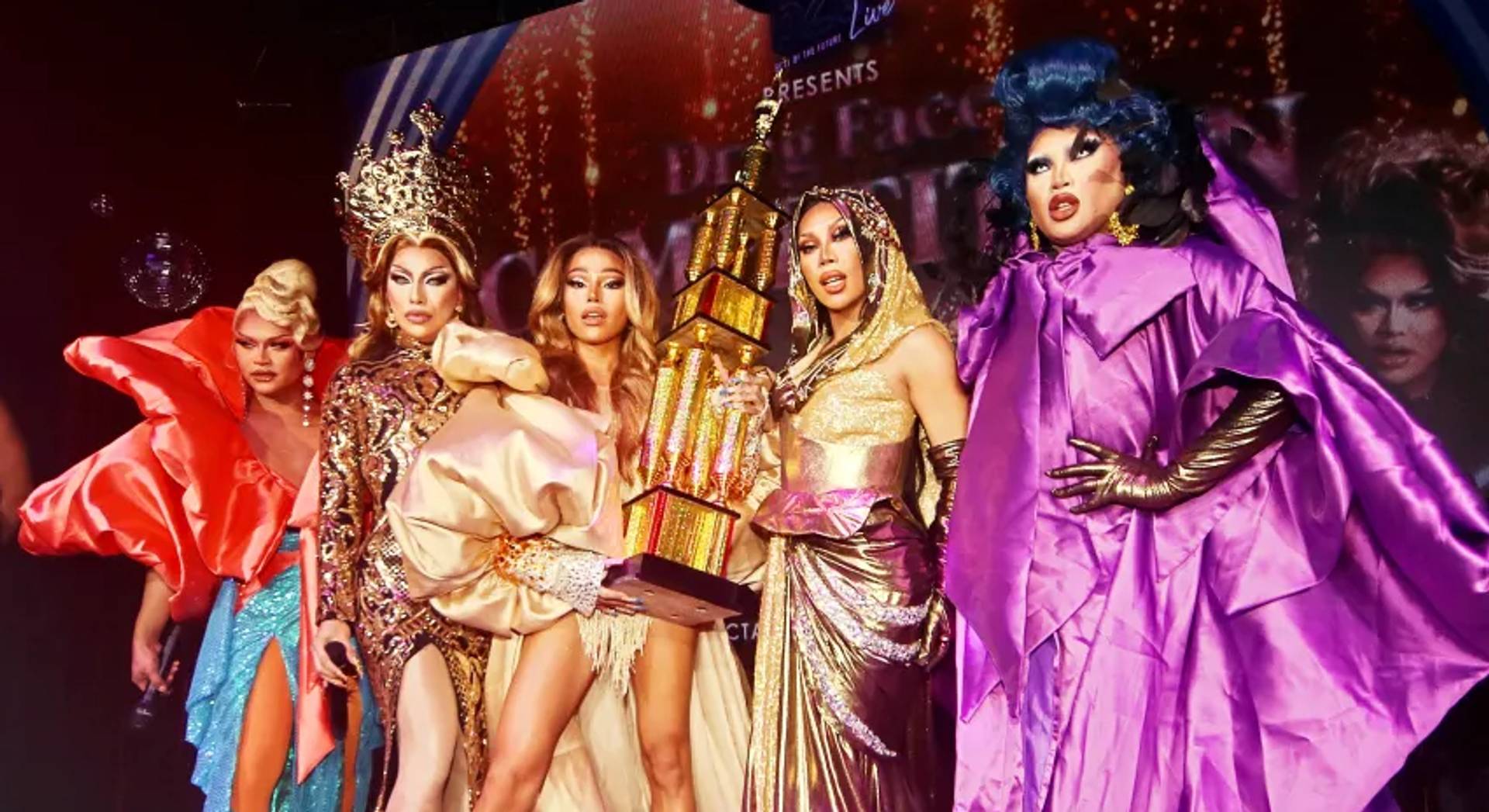
The Playhouse is a drag production house in the Philippines that aims to make drag a mainstream art form in the Philippines. Apart from producing sold-out live events and online content, The Playhouse also pioneers initiatives to create safe spaces for all genders in the Philippines. Last year, it launched the Drag Space Project, in partnership with the Department of Justice Action Center (DOJAC), Kababaihan Organization and Rainbow Rights, featuring a seminar on anti-sexual harassment and the Safe Spaces Act that was specially designed for the drag community. Eva Le Queen, president of The Playhouse, told Inquirer, “Education is always the key. We don’t have enough of it right now. Gender sensitivity is part of our industry, and this needed to be done.”
– Klara Iskra Añonuevo, lead copy and production editor